
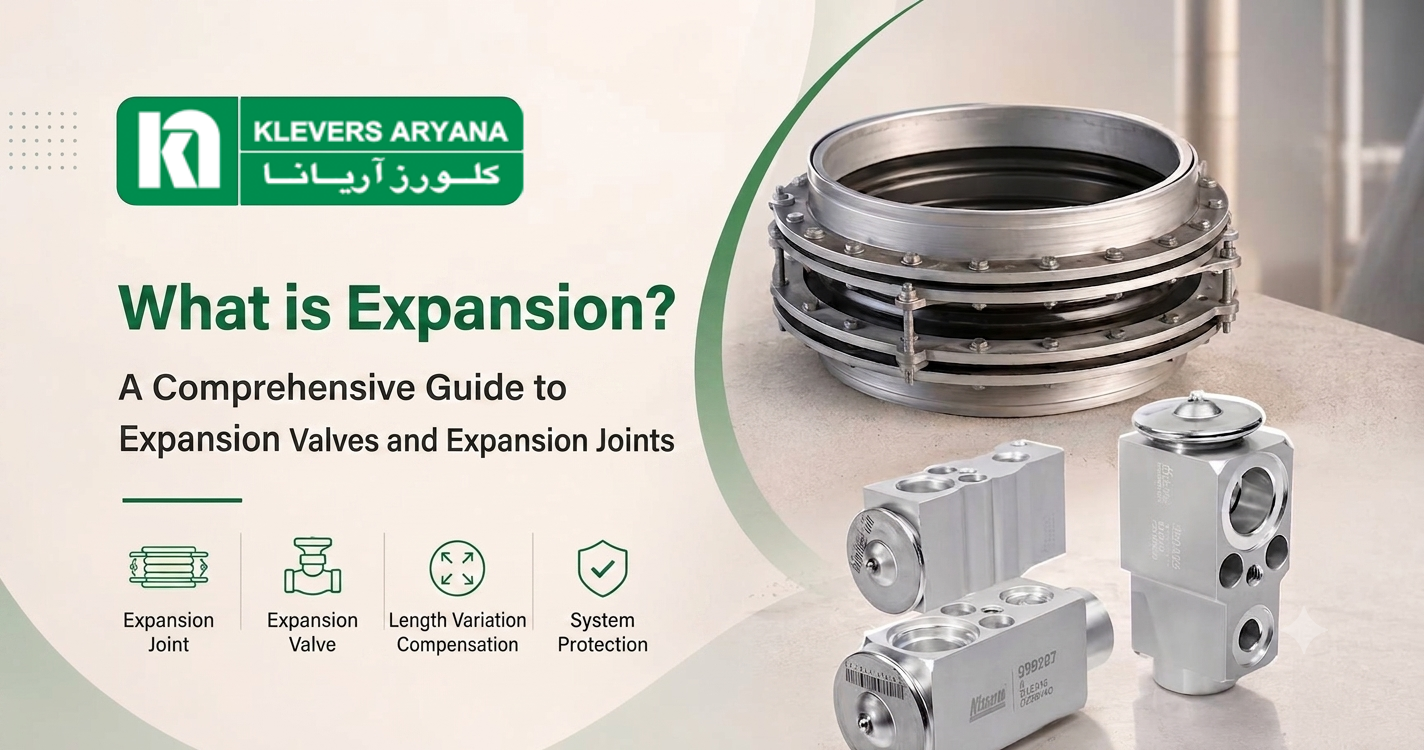

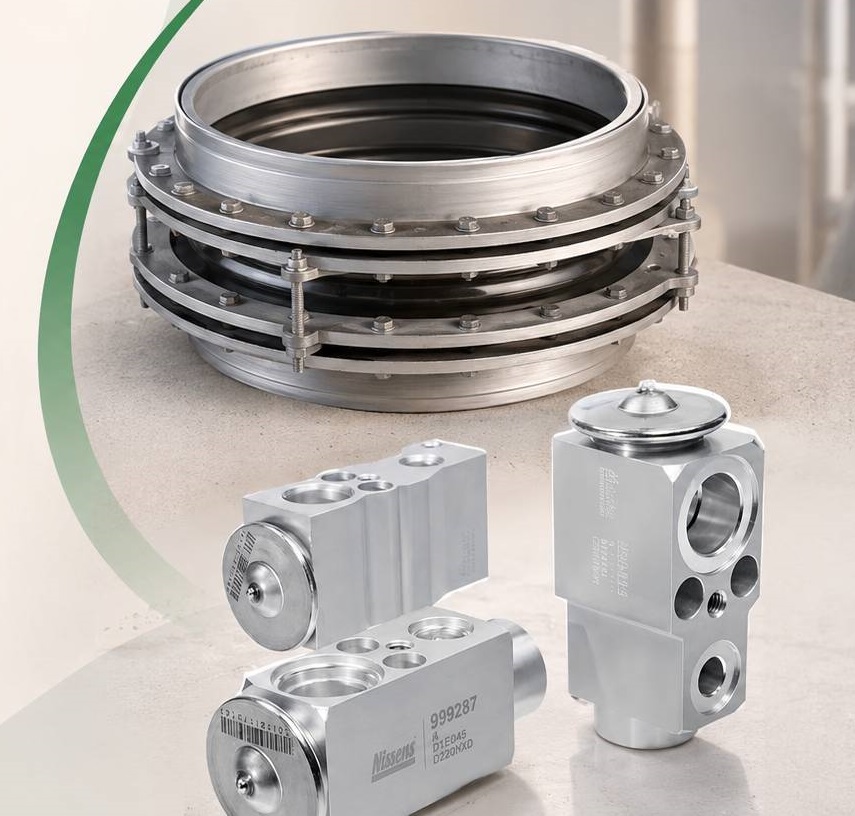
If the term «Expansion» takes you into the world of cooling systems and your repair colleague uses it to fix a pipe tension issue, you are not alone. In the industry, «Expansion» is a key dual-purpose word that refers to both the Expansion Valve in the refrigeration cycle and the Expansion Joint that protects pipes and equipment from thermal expansion. This guide helps you know exactly which one is meant without confusion, and familiarizes you with both applications, standards, and technical features.
Expansion Valve: The Control Brain of the Refrigeration Cycle
At the heart of every compression refrigeration system lies a small but vital component called the Expansion Valve. This part is located on the liquid line, between the condenser and the evaporator, and has a dual function:
- Sudden reduction of refrigerant pressure: As the refrigerant passes through a narrow orifice, its pressure drops sharply, preparing it for evaporation in the evaporator.
- Precise regulation of refrigerant flow: It controls the amount of refrigerant entering the evaporator according to the heat load, ensuring neither liquid returns to the compressor (liquid slugging) nor the evaporator remains starved.
Types of Expansion Valves
- Thermostatic Expansion Valve (TEV): The most common type, which opens and closes based on the temperature of the outlet gas (superheat) sensed by a bulb.
- Electronic Expansion Valve (EEV): Very high precision, fast response to load changes, and controllable via PLC.
- Capillary Tube: The simplest and cheapest type for small systems with a constant load.
If you are looking to buy or troubleshoot an expansion valve, be sure to check parameters such as capacity (Ton of Refrigeration), refrigerant type (R134a, R404A, R407C), and the evaporation temperature range.
Expansion Joint: The Silent Protector of Piping Lines
Unlike the expansion valve which works inside the refrigeration cycle, the Expansion Joint is one of the most strategic pieces of equipment in industries such as oil, gas, petrochemicals, power plants, steel, and cement. Any pipeline subject to temperature changes will expand and contract. If these movements are not accommodated, immense stresses are transferred to flanges, supports, and the pipe itself, resulting in dangerous leaks, flange breakage, and production line shutdowns.
For a deeper understanding of this product, please study the Complete Encyclopedia of Expansion Joints (Types of Expansion Joints: Metallic, Fabric, Rubber), which is the essence of 40 years of Klevers Aryana experience.
The Large Family of Expansion Joints
| Type | Material | Temperature Range | Main Application |
|---|---|---|---|
| Metallic | Stainless Steel 304/316, Inconel | -200 to 1000+ °C | Steam lines, hot gases, refineries |
| Fabric | Ceramic fiber, Fiberglass with silicone coating | Up to 1200 °C (low pressure) | Turbine exhaust gas ducts, chimneys |
| Rubber | EPDM, NBR, Neoprene with reinforcement layers | -40 to 120 °C | Marine water systems, corrosive chemicals, power plants |
Metallic Expansion Joint
The most resistant option for high pressure and temperature. With multi-ply bellows design and reinforcement rings, it easily absorbs axial, lateral, and angular movements. For complete technical information and a buying guide, refer to Introduction to Metallic Expansion Joints: Types, Advantages, Application, and Buying Guide.
Fabric Expansion Joint
At very high temperatures where metal softens, engineered fabrics take over. Their exceptional flexibility and low weight make installation extremely easy. To see examples, check out Fabric Expansion Joint: Introduction, Advantages, and Buying Guide + Photos.
Rubber Expansion Joint
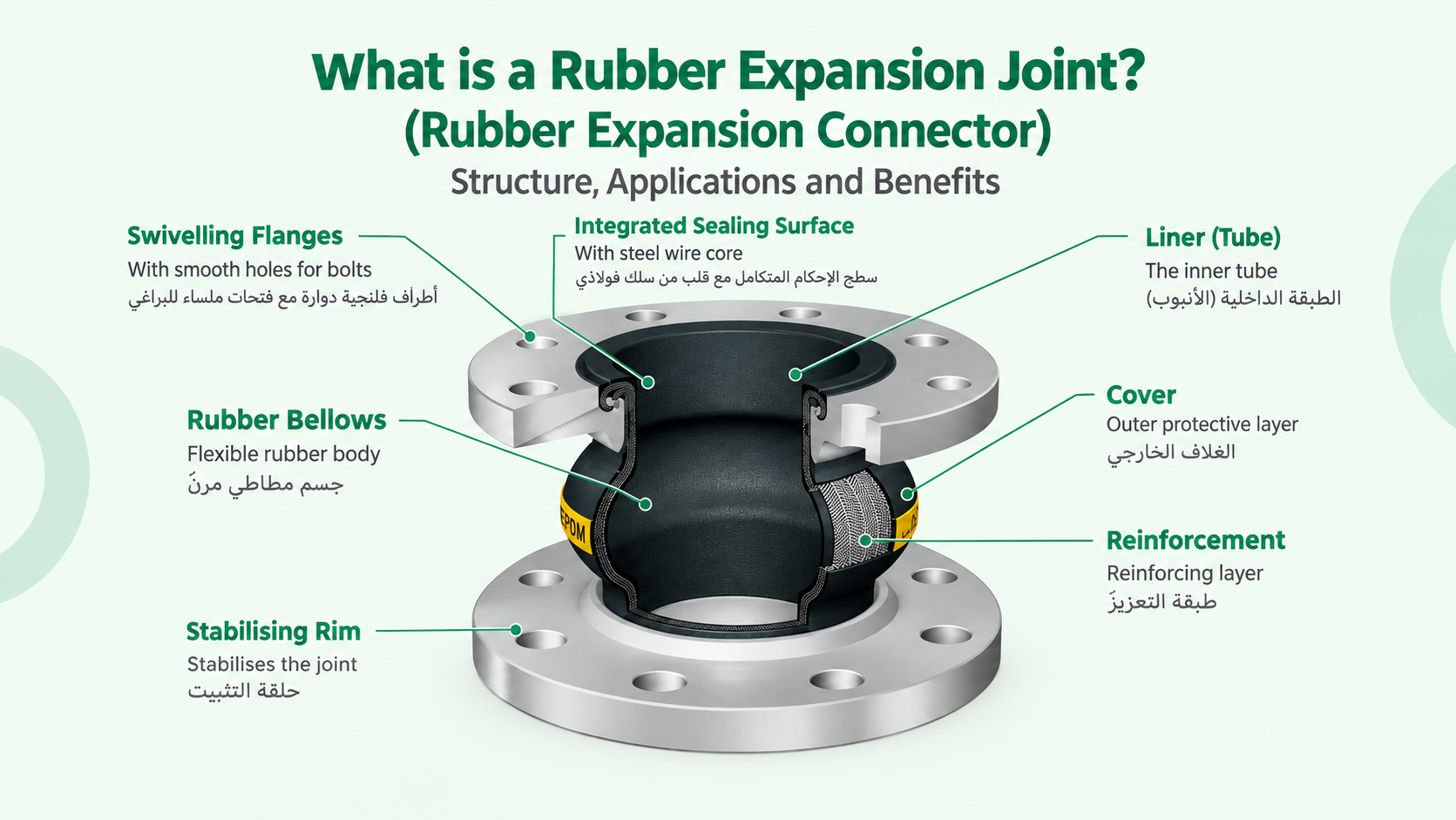
Designed to absorb vibration, shock, and noise in pumping systems and liquid transfer lines. Its high chemical resistance to acids and bases makes it an unrivaled choice in the chemical industry. Follow the page Rubber Expansion Joint for more detailed information.
Comparison Table: Expansion Valve vs. Expansion Joint
| Feature | Expansion Valve | Expansion Joint |
|---|---|---|
| Main Purpose | Pressure reduction and refrigerant flow control | Absorbing thermal expansion, vibration, and misalignment |
| Installation Location | Liquid line between condenser and evaporator | On pipelines, ducts, pump inlets |
| Nature | Flow control valve | Flexible mechanical connection |
| Target Industries | HVAC, cold storage, chillers | Oil, gas, petrochemical, steel, power plants, cement |
| Key Parameter | Cooling capacity (Ton of Refrigeration) | Movement capability (Axial, Lateral, Angular) |
Common Challenges and Maintenance Musts
Even the best expansion joint, if installed incorrectly, will quickly become a point of failure. Review the Golden Tips for Installation and Maintenance of Expansion Joints before any action. In case of premature failures, especially in metallic models, Metallic Expansion Joint Failure: Causes, Prevention, and Expert Solutions tells you the root of the problem: wrong design, unsuitable material, excessive misalignment, or thermal fatigue.
Standards and Technical References (External Links)
The selection and design of expansion joints are based on international standards. To understand design requirements, we recommend referring to the Expansion Joint Manufacturers Association (EJMA) Guide.
Additionally, all Klevers Aryana products are designed and tested according to API, ASTM, and ISO standards to ensure your peace of mind in critical processes.
Conclusion
Now you know that Expansion, depending on the context, refers either to the expansion valve in cooling systems or the expansion joint in piping lines. If you are facing challenges with thermal expansion, vibration, and misalignment in your pipeline, it is time to select a suitable Expansion Joint with the help of experts.
The engineering team at Klevers Aryana, with over 40 years of experience in supplying and manufacturing expansion joints and industrial water treatment systems, is ready to provide free technical consultation, site visits, and propose the best solution tailored to your pressure, temperature, and fluid.
📞 Free Consultation Phone: 021-91008181
📧 Email: info@klevers-aryana.com
🌐 Website: klevers-aryana.com