
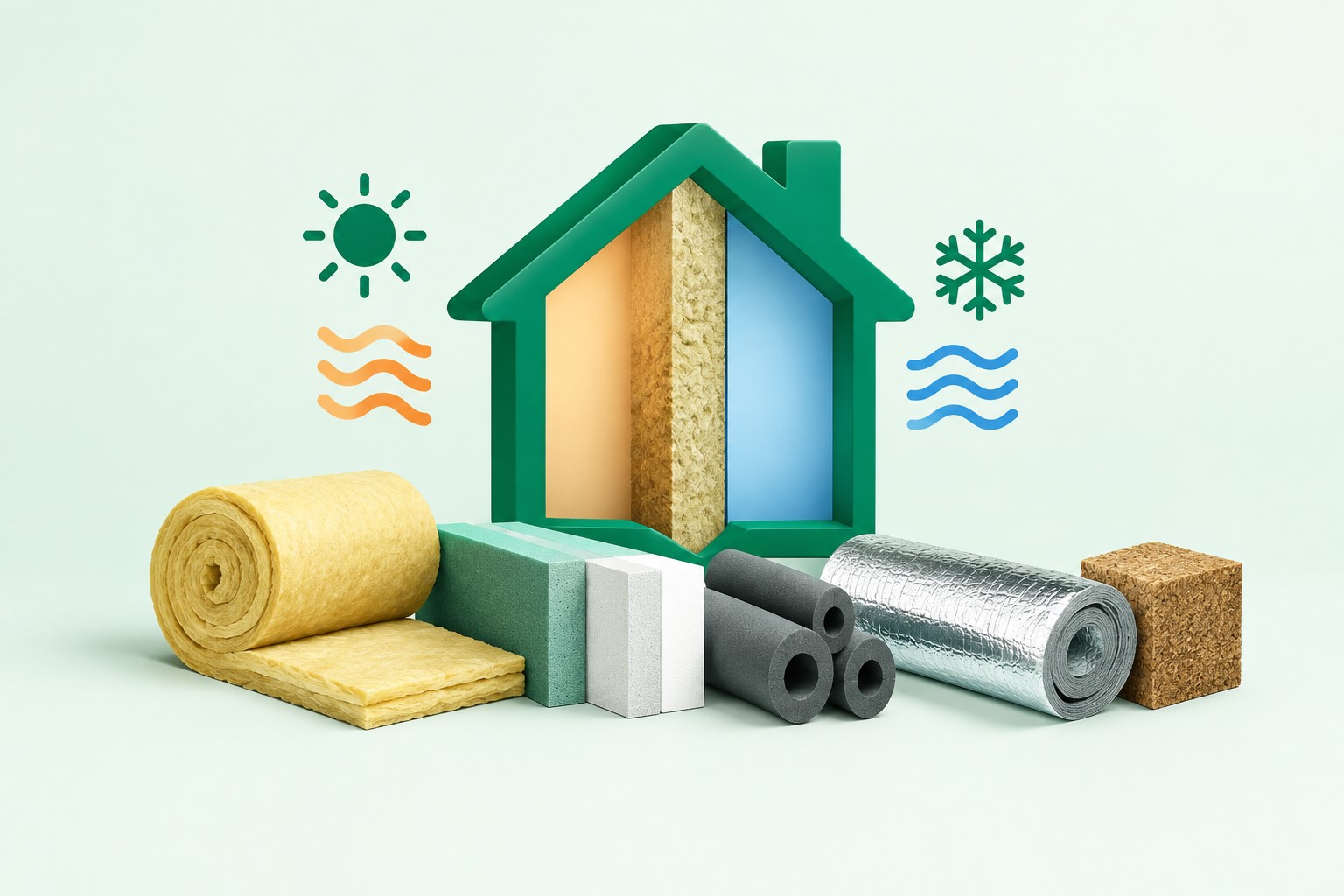

Thermal insulation is a material with low thermal conductivity that slows the flow of heat between two environments with different temperatures. For this reason, it is used in buildings, piping, facilities, vehicles, and heavy industries to reduce energy loss, maintain desired temperature, and increase safety. Choosing the right insulation depends on three things: operating temperature, place of use (building or industry), and budget.
In this guide, you will learn how thermal insulation works, what types exist, which type is suitable for what application, what factors affect its price, and how to choose the right insulation for your project.
Table of Contents
- How does thermal insulation work?
- Types of thermal insulation by material
- Types of thermal insulation by form
- Comparison table of thermal insulation types
- Building thermal insulation (wall, roof, floor)
- Industrial thermal insulation
- How to choose the right insulation?
- Factors affecting the price of thermal insulation
- Frequently asked questions
How does thermal insulation work?
Heat always transfers from a warmer environment to a colder one, and this transfer occurs in three ways: conduction (through direct contact of materials), convection (through the movement of air or liquid), and radiation (through thermal waves). Insulators usually prevent conduction and convection by trapping still air in their porous or cellular structure. Reflective insulators such as aluminum foil also reflect part of the radiation.
Two main indicators for comparing insulators:
- Thermal conductivity coefficient (λ, unit W/m·K): The lower it is, the better the insulation.
- Thermal resistance (R): Obtained by dividing thickness by conductivity coefficient. The higher it is, the better the performance.
Types of thermal insulation by material
1. Fibrous insulations
Glass wool: Made from fine glass fibers, it is lightweight and inexpensive and suitable for buildings, air ducts, and pipes. For continuous use, it is usually recommended up to about 250 degrees Celsius.
Rock wool: Produced from melted basalt stone, it has good resistance to fire and sound and is used for higher temperatures (up to about 600 degrees, depending on the product type).
Ceramic fibers: Specifically for very high temperatures such as furnaces; depending on the grade, up to more than 1200 degrees Celsius.
2. Foam and polymer insulations
Polystyrene (EPS and XPS): Lightweight and economical and common in wall, roof, and floor insulation of buildings. Their operating temperature is limited and they are not suitable for high temperatures.
Polyurethane (PU) and polyisocyanurate (PIR): Very good insulation coefficient with low thickness. They are used in sandwich panels, cold storage, cooling pipes, and tanks.
Elastomeric foam: Specifically for cooling and heating facility pipes and preventing condensation.
3. Reflective insulations
Aluminum roll (foil): Works by reflecting thermal radiation and is often used together with foam or glass fibers. It is common for under sloped roofs, ducts, and facilities.
4. Liquid and paint insulations
Coatings containing ceramic or nano particles that are applied to the surface. These products are mostly useful for reducing radiation absorption and helping supplementary insulation and should not be considered a replacement for thick insulation in main projects.
Types of thermal insulation by form
- Roll: Glass wool and aluminum foil; suitable for large surfaces.
- Panel and board: Rock wool, XPS, polyurethane; suitable for walls, roofs, and floors.
- Shell (coil): Specifically for pipes and ducts.
- Blanket and module: Ceramic fibers for furnaces.
- Spray: Polyurethane foam that is sprayed onto the location and has no seams.
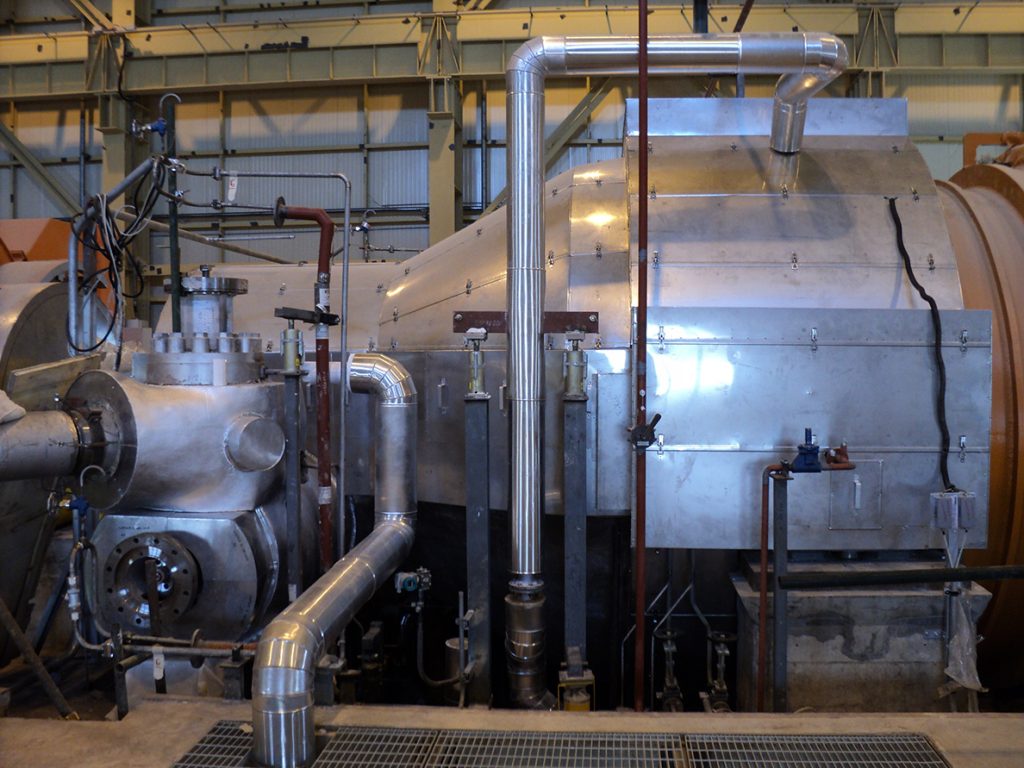
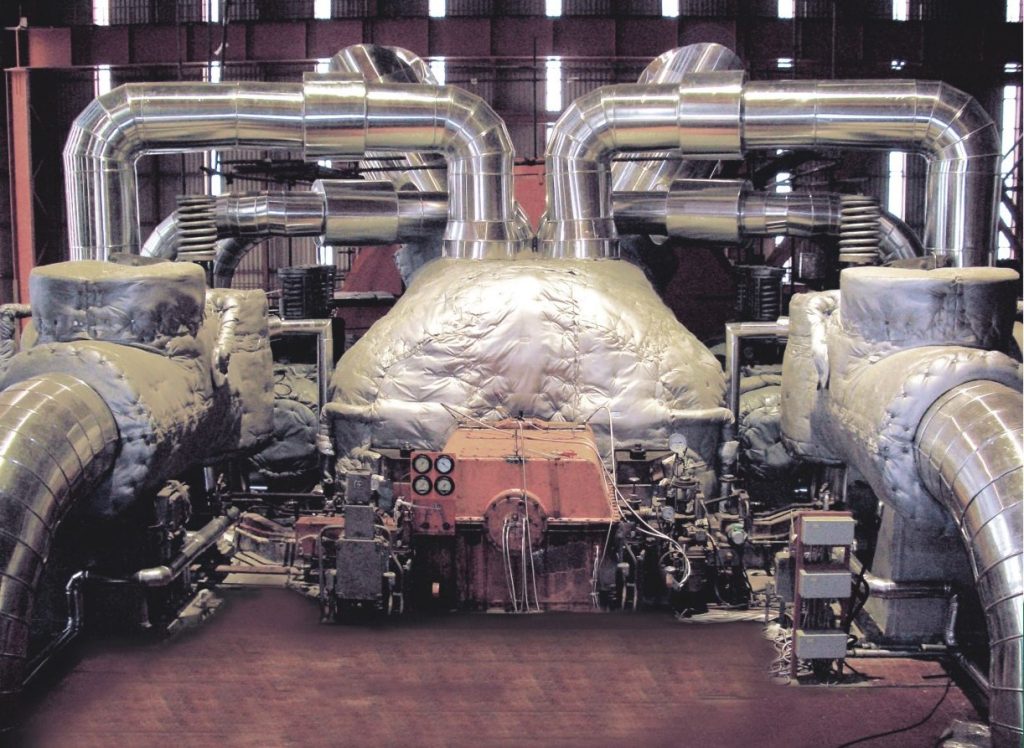
- Jacket (removable insulation blanket): For valves, turbines, flanges, and equipment that must be inspected.
- Liquid and adhesive: Surface coatings.
Comparison table of thermal insulation types
The numbers below are approximate and for general comparison; get the exact value from the manufacturer’s technical specifications.
| Insulation type | Approximate operating temperature | Approximate thermal conductivity coefficient (W/m·K) | Main advantage | Limitation | Common application |
|---|---|---|---|---|---|
| Glass wool | Up to about 250°C | 0.032 to 0.044 | Inexpensive, lightweight, sound insulation | Moisture absorption if unprotected | Building, duct, pipe |
| Rock wool | Up to about 600°C | 0.035 to 0.045 | Fireproof, sound insulation | Heavier than glass wool | Building, boiler, hot pipe |
| Ceramic fibers | More than 1200°C (depending on grade) | Depends on temperature | Resistance to thermal shock | Higher cost | Furnaces |
| Polystyrene (EPS) | About 75°C | 0.033 to 0.040 | Economical, lightweight | Flammable, low temperature | Wall, floor, packaging |
| XPS | About 75°C | 0.029 to 0.036 | Resistant to moisture and pressure | Higher price than EPS | Floor, foundation, roof |
| Polyurethane / PIR | From minus 40 to about 120–150°C | 0.022 to 0.028 | Best insulation at low thickness | Sensitivity to fire (in PU) | Cold storage, panel, tank |
| Elastomeric foam | Up to about 100–150°C | 0.033 to 0.040 | Flexible, anti-condensation | Temperature limitation | Facility pipes |
Building thermal insulation
In buildings, insulation reduces heating and cooling energy loss and improves occupant comfort. The greatest loss usually occurs through the roof, exterior walls, windows, and floor.
- Exterior wall: Insulation from the outside (facade) usually has fewer thermal bridges; rock wool, XPS, or EPS is used.
- Roof and ceiling: Glass wool, rock wool, polyurethane, or waterproofing with insulation; moisture sealing is important.
- Floor: Usually XPS or high-density EPS due to compressive strength.
- Simultaneous sound insulation: Rock wool and glass wool reduce sound in addition to heat.
Industrial thermal insulation
In industry, the operating temperature is much higher or lower than in buildings, and the insulation must withstand heat, chemicals, vibration, and moisture. Common cases:
- Pipes and tanks in refineries and petrochemicals
- Boilers and furnaces in power plants and metal industries
- Valves and turbines that require periodic inspection
For easy inspection and repair, jacket insulations (pillow and cladding design) are a common option because they can be reopened and reclosed. For more complete information, see the following articles:
- Industrial Thermal Insulation: Types, Applications, and Standards
- Turbine Insulation: Comparison of Jacket Insulation Types
How to choose the right insulation?
1. Determine the operating temperature. This is the most important criterion. The insulation must withstand the continuous operating temperature of the surface. 2. Know the place of use. Building, hot pipe, cold pipe, vehicle, or furnace have different needs. 3. Consider moisture and chemicals. In humid or corrosive environments, closed-cell insulation or one with a suitable covering is more appropriate. 4. Check fire safety. Rock wool and ceramic are fireproof; foams usually require additives or covering. 5. Consider installation and inspection capability. For equipment that is opened frequently, jacket insulation is better. 6. Calculate the total cost. Do not look only at the price per square meter; also consider energy savings and service life.
Factors affecting the price of thermal insulation
The price of insulation is not fixed and depends on these factors:
- Material type and quality (polystyrene to ceramic fibers have a large price difference)
- Density and thickness
- Product form (roll, panel, shell, module, or custom jacket)
- Covering and fabric (aluminum, fiberglass, silica, stainless steel)
- Operating temperature and quality certificates
- Fluctuations in raw material and currency prices
- Installation and transportation cost
To receive an exact price, provide the operating temperature, dimensions, and place of use to the supplier and be sure to request the technical specifications and product datasheet. Get a quote now by calling 021 – 91305505.
Frequently asked questions
Which is the best thermal insulation? There is no absolute “best” insulation. For buildings, usually rock wool, glass wool, or XPS; for cold storage and low thickness, polyurethane; and for high temperatures, rock wool or ceramic fibers are more suitable.
What is the difference between thermal insulation and sound insulation? Thermal insulation reduces heat transfer and sound insulation reduces sound transfer. Some materials such as rock wool have both properties to some extent, but for professional results, separate design is usually necessary.
Does liquid thermal insulation replace ordinary insulation? Usually not. These coatings are mostly supplementary and their performance depends on the product type and application method. For reliable results, pay attention to technical specifications and independent tests.
Is thermal insulation also effective in summer? Yes. Insulation prevents both heat loss in winter and heat entry in summer.
What is the service life of thermal insulation? Depending on the material, environmental conditions, and installation quality, usually decades for building insulation and less for harsh industrial conditions; periodic inspection is important.
Is jacket insulation different from ordinary insulation? Yes. Jacket insulation is a sewn insulation blanket with fireproof fabric that is installed on measurement equipment and is suitable for reopening and re-closing, unlike fixed insulations.
What is thermal insulation for cars? In vehicles, foam, rubber, and aluminum foil insulations are used to reduce heat and noise from the engine and floor. The choice must be compatible with the installation area temperature and vehicle standards.
Conclusion
Thermal insulation, by reducing energy loss, both lowers costs and increases safety and comfort. The right choice means matching the material, form, and thickness of the insulation to the operating temperature and environmental conditions. If your project is industrial and needs jacket insulation, cladding, or valve insulation, you can consult with Klevers Aryana experts.
- To learn more about insulation principles, read Section 19 of the Iranian National Building Regulations.